27 September, 2026
Sunday
Ai
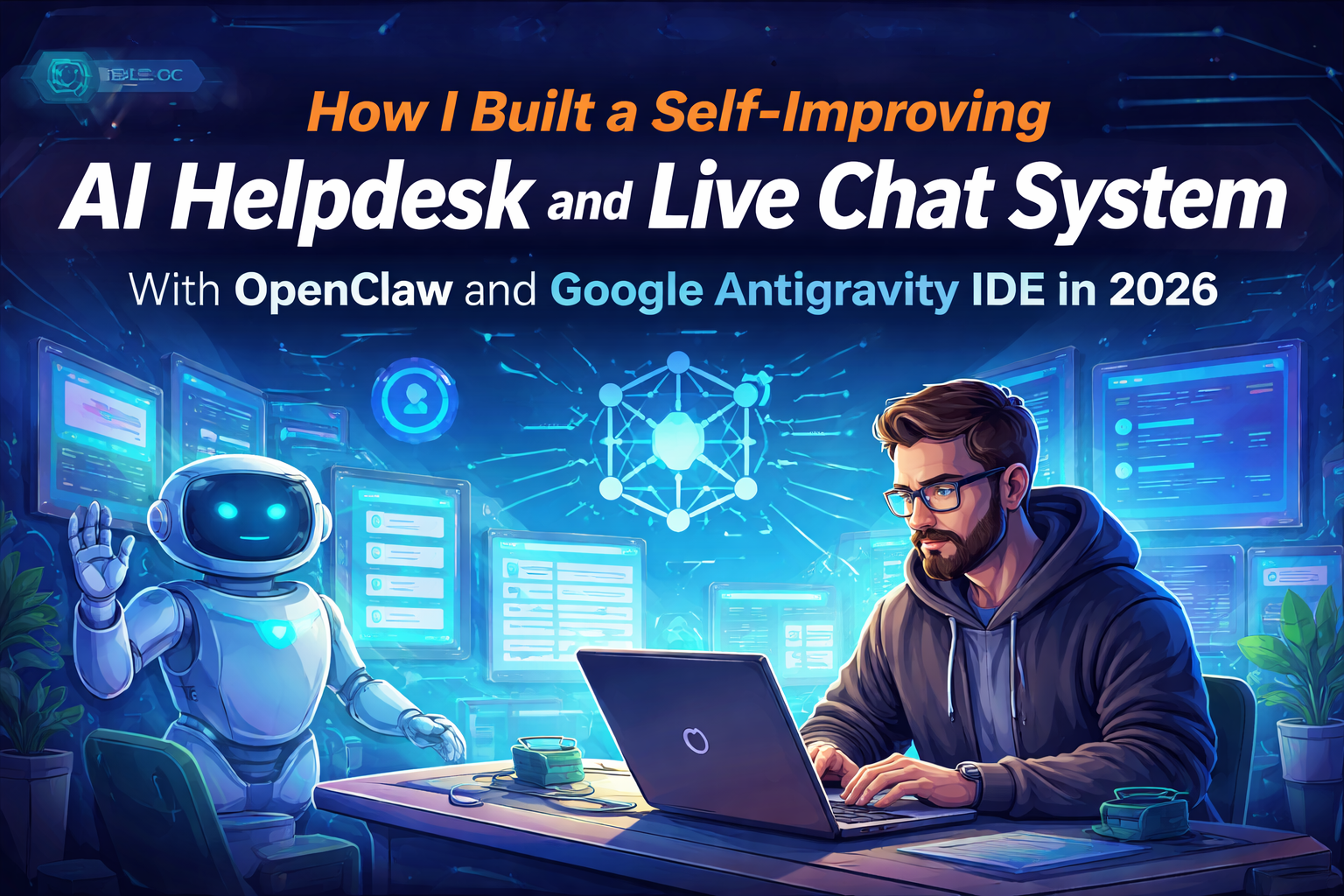
How I Built a Self-Improving AI Helpdesk and Live Chat System With OpenClaw and Google Antigravity IDE in 2026
In 2026, a founder no longer needs to depend entirely on expensive closed SaaS platforms to build a strong customer support operation.
It is now entirely possible to build an advanced AI helpdesk and AI live chat stack that is more adaptable, more transparent, and more capable of continuous improvement than many traditional products sold on the market. That is exactly the direction I have taken.
Instead of relying on a single packaged vendor solution, I built a modular support environment by combining OpenClaw, Google Antigravity IDE, selected open-source customer support projects, useful scripts and ideas found on GitHub, and custom middleware to connect everything together.
The result is not just another helpdesk. It is a self-improving customer support system designed to help both customers and staff while getting better over time.
Core Stack Used
The core stack behind this build includes:
-
OpenClaw for AI orchestration, workflows, routing, guardrails, and operational control
-
Google Antigravity IDE for fast development, inspection, testing, and iteration
-
Open WebUI as the internal staff-facing AI portal
-
LiveHelperChat as the public-facing live chat platform
-
osTicket as the helpdesk and ticketing layer
-
GitHub source projects and scripts used to accelerate development and integration
-
Custom middleware and synchronization logic to connect the parts into one coherent system
-
Dedicated AI agents for specific functions rather than one overexposed general system
This combination matters because it gives me the flexibility of open-source foundations while still allowing a higher-level AI architecture to sit above them.
The Main Idea Behind the System
Most support platforms still suffer from the same basic problem: they are too static.
They may offer ticketing, chat, automation, and maybe an AI assistant, but in practice many of them are still slow to improve. Internal staff knowledge is often disconnected from customer-facing answers, feedback loops are weak, and making meaningful changes usually depends on vendor limitations, slow interfaces, or a fragmented set of tools.
I wanted to build something different.
My goal was to create a support system where:
-
customers can interact through live chat,
-
issues can move into structured helpdesk workflows,
-
staff can interact with an internal AI support layer,
-
weak answers can be improved quickly,
-
and the overall system can evolve continuously instead of staying static.
That is the real difference.
Why OpenClaw Matters
A major reason this system works well is the use of OpenClaw as the orchestration layer.
I do not treat AI as a generic chatbot pasted onto a website. I treat it as part of a controlled operational system. OpenClaw makes that possible by managing AI roles, workflows, task routing, guardrails, internal logic, and continuous improvement processes.
That means the intelligence in the support environment is not random. It is structured.
Instead of one broad public-facing AI endpoint, different parts of the system can be assigned different responsibilities. That makes the environment easier to control, easier to improve, and safer to operate over time.
Why Google Antigravity IDE Matters
The development side matters just as much as the architecture.
Google Antigravity IDE gives me the ability to move quickly across system inspection, prompt logic, integrations, configuration, testing, and improvement work. It is a major part of what makes iterative building practical.
When combined with OpenClaw, it allows me to do more than simply deploy tools. It lets me shape how the tools behave, how they connect, how they are reviewed, and how they improve over time.
That is a very different model from buying a support platform and only using whatever settings the vendor happens to expose.
Building on Open Source Instead of Reinventing Everything
One of the most important lessons from this project is that in 2026 you do not need to build every layer from zero in order to build something advanced.
There are already many excellent open-source projects available. The real skill is understanding how to evaluate them, combine them, secure them, improve them, and make them function together as one business-ready system.
That is what I focused on.
I used strong upstream projects for the major support layers, then extended them with custom middleware, AI routing, synchronization logic, workflow structure, and improvement mechanisms. I also used useful scripts, ideas, and project references found on GitHub to accelerate progress and reduce unnecessary redevelopment.
This is one of the real advantages available to builders today.
The winners are not necessarily the people who write every single component from scratch. The winners are the people who know how to assemble the right systems and then improve how they work together.
The Self-Improving Customer Support Loop
This is the part that makes the system especially powerful.
A lot of helpdesk and live chat systems can answer questions. Far fewer are designed to improve their answers in a tight, practical loop.
Traditional systems usually fail like this:
-
a customer asks something unusual,
-
the answer is weak or incomplete,
-
staff notice the problem later,
-
someone eventually updates a help article or internal note,
-
and the same issue may continue in the meantime.
That lag is where service quality breaks down.
I wanted a faster loop.
So I designed the architecture so interactions can be reviewed, knowledge gaps can be identified, staff can improve weak answers, and the knowledge source can be updated in a way that strengthens the system over time. Once the improvement is made, it can support both helpdesk and live chat behavior rather than being trapped in one person’s memory.
That is what makes the stack self-improving rather than just automated.
Internal AI Support for Staff
One of the strongest practical benefits of this model is the internal staff experience.
In many businesses, staff knowledge is scattered across tickets, chat threads, old documents, team memory, and informal workarounds. That leads to inconsistency, slower onboarding, and uneven customer support quality.
I wanted staff to have something more direct: the ability to interact with an internal AI support layer that helps them refine answers and strengthen the knowledge flowing into the wider support environment.
This is important because staff are often closest to real customer questions.
Instead of treating staff as passive users of a support platform, this architecture allows them to become active participants in the improvement loop. They can identify where answers are weak, interact with the internal AI layer, and help improve how the system responds in the future.
That is a major reason this approach can outperform many off-the-shelf systems.
Security and System Separation
A key design decision in this architecture is separation between the public-facing live chat layer and the internal OpenClaw orchestration system.
For security, the public live chat is not connected directly to OpenClaw. The public has no direct access to my OpenClaw system. Instead, customers interact only with a dedicated LiveHelperChat agent layer.
That design matters.
It means I do not expose my internal orchestration environment directly to the public internet through customer chat. By separating the layers, I reduce the attack surface, keep internal AI workflows protected, and maintain stronger control over how public interactions are handled.
In practical terms, this creates a cleaner and safer architecture:
-
the public talks to the customer-facing chat layer,
-
internal orchestration remains isolated,
-
and the more sensitive AI workflow logic stays protected behind that boundary.
This is one of the reasons I believe custom-built AI support systems can be superior to many commercial platforms when they are designed properly.
Why This Can Be Better Than Many Commercial Support Platforms
There are many good SaaS support tools on the market, but many of them still come with familiar limitations:
-
ongoing licensing costs,
-
limited visibility into system behavior,
-
restricted AI customization,
-
slow improvement cycles,
-
vendor lock-in,
-
and weak integration flexibility.
By contrast, the model I built is designed to be:
-
more flexible, because each layer can be improved or replaced,
-
more self-improving, because staff feedback and knowledge updates can tighten the loop,
-
often more cost-efficient, because open-source foundations reduce software overhead,
-
more controllable, because workflows and AI behavior can be shaped directly,
-
and more adaptable, because the system can evolve with the business instead of waiting on vendor roadmaps.
That does not mean every company should abandon commercial platforms. But it does show that founders and operators now have a real alternative if they are willing to think more strategically about architecture.
Key Benefits
The clearest benefits of this approach are:
-
Faster improvement of support quality through a tighter feedback and update loop
-
Better staff assistance through an internal AI support layer
-
More flexibility than many closed commercial helpdesk products
-
Often lower long-term software cost due to open-source foundations
-
Better control over workflows and AI behavior
-
Reduced attack surface through separation of public chat from internal orchestration
-
Easier long-term adaptation as needs, products, and support processes evolve
These are not theoretical benefits. They are exactly the kinds of advantages that matter when support systems need to operate in real business environments.
My Role in the Build
What I am most proud of is not simply that the system works.
It is that I was able to combine modern AI tools, open-source software, GitHub-discovered projects and scripts, and business-focused systems thinking into a practical support architecture that keeps improving over time.
This required more than installing software.
It required:
-
identifying the right source projects,
-
understanding where each tool should sit in the architecture,
-
designing the interaction model between public support, internal support, and structured helpdesk workflows,
-
setting boundaries and guardrails for AI use,
-
building the improvement loop,
-
and making sure the overall system was useful in operational reality, not just technically interesting.
That is where I believe a lot of the value sits today.
The opportunity is no longer just in writing code. It is in knowing how to combine systems, shape workflows, and turn modern AI tools into something genuinely useful for the business.
What This Says About 2026
We are now at a point where builders are no longer limited to what a single software vendor decides to sell them.
With the right approach, it is possible to combine OpenClaw, Google Antigravity IDE, open-source support platforms, GitHub-discovered tooling, AI agents, and custom scripts into something more specialized and often more capable than many prepackaged systems.
That is one of the biggest shifts happening right now.
The future belongs to people who can orchestrate systems well, not just consume them.
Final Thoughts
For me, this project is about more than just creating a helpdesk or a live chat tool.
It is a real example of how modern customer support systems can be built in 2026: connected, modular, self-improving, security-conscious, and shaped around the real needs of staff and customers.
Using OpenClaw, Google Antigravity IDE, upstream open-source projects, GitHub tooling, AI agents, and custom middleware, I have been able to create an AI helpdesk and AI live chat environment that is practical today and designed to keep getting better.
And this is only the beginning.
The next generation of customer support systems will not be defined simply by whether they include AI. They will be defined by how well that AI is structured, controlled, improved, and operationalized.
That is the direction I am building toward.
Original GitHub Source Repositories
The original upstream GitHub projects used as the foundation for this support stack were:
-
Open WebUI —
open-webui/open-webui -
LiveHelperChat —
LiveHelperChat/livehelperchat -
osTicket —
osTicket/osTicket
These projects provided the core building blocks. The differentiation came from how I combined them with OpenClaw, Google Antigravity IDE, custom middleware, synchronization logic, operational guardrails, and a self-improving AI workflow.