12 October, 2026
Monday
GENERAL
Losing Control — Why Australia Urgently Needs Payment Sovereignty
The Invisible Toll: What Happens When You Tap Your Card?
Every time you buy a coffee, pay for groceries, or tap your phone at a local Australian business, a silent transaction occurs behind the scenes. You see your local bank's name on your card, and the business uses a local terminal. You might think this is an entirely Australian exchange.
It isn’t.
Because that plastic card in your wallet bears the logo of Mastercard or Visa—both multi-billion-dollar conglomerates based in the United States—a slice of that transaction, along with critical transaction data, bypasses Australian soil entirely.
This is the core issue of payment sovereignty: the ability of a nation to independently operate, regulate, and secure its own financial transaction networks without being beholden to foreign corporations or foreign laws. Right now, Australia is rapidly losing its grip on it.
The Illusion of Choice: How the US Duopoly Controls Australian Rails
Mastercard, Visa, and American Express are the undisputed giants of global payments. In Australia, they have successfully embedded themselves into the very fabric of our financial system.
Even when you are transacting domestically—using an Australian bank account to buy goods from an Australian merchant—the payment rails routing that money are owned and operated by foreign entities.
This dependency creates three critical vulnerabilities:
-
The Foreign "Tax": A percentage-based fee on almost every credit and debit transaction leaves our shores, flowing directly to the USA. This is an invisible drain on the Australian economy, raising costs for merchants and inflating prices for consumers.
-
Loss of Legal and Regulatory Control: Because our local cards are bound by licensing agreements with US companies, the Australian Government and local regulators do not have ultimate control over our own payment infrastructure. We are subject to terms, rules, and privacy policies drafted in corporate boardrooms in New York and California.
-
Data Security and Jurisdiction: Your transactional metadata—where you spend, when you spend, and how much you spend—is routed through foreign networks, putting our citizens' financial privacy under the jurisdiction of foreign laws.
How the Rest of the World is Fighting Back
While Australia remains comfortable in the grip of US credit card networks, other nations have recognized the geopolitical and economic dangers of foreign payment dominance. They are actively reclaiming their payment sovereignty.
1. Europe: The Push for Full Sovereignty
The European Union has long sounded the alarm on its reliance on US payment rails. Through initiatives like the European Payments Initiative (EPI) and strict data sovereignty laws (GDPR), Europe is working to establish a unified domestic instant payment system that bypasses foreign card schemes entirely, ensuring European financial data stays in Europe.
2. China: The QR-Code Revolution
China bypassed the Western credit card era entirely. By building a domestic, mobile-first ecosystem powered by digital wallets like Alipay and WeChat Pay, China secured complete domestic control over its payment infrastructure. Transactions are instant, virtually free for small merchants, and entirely domestic.
3. Southeast Asia: The Rise of 'PromptPay' and Instant Bank Transfers
Perhaps the most successful model for Australia to study is currently operating in Southeast Asia.
-
Countries like Thailand (PromptPay), Malaysia (DuitNow), Vietnam, and Cambodia have built highly integrated, mobile bank-to-bank instant transfer networks.
-
Instead of swiping a Visa card, consumers simply scan a standardized QR code to transfer funds instantly from their bank account to the merchant's bank account.
-
The Result: These systems are completely free or cost pennies to run, bypass expensive foreign networks entirely, and now account for over 80% of domestic payments in these countries.
Australia's Failed Promise: The PayID Stagnation
Australia actually has the technology to mimic these highly successful international systems. We have the New Payments Platform (NPP) and PayID—a system designed to allow instant, secure, fee-free bank-to-bank transfers.
But while Southeast Asia used similar technology to revolutionize retail payments, Australia’s rollout has stalled.
PayID is largely relegated to peer-to-peer transfers (like splitting a dinner bill with a friend). Because our major banks and financial institutions profit handsomely from their partnerships with Visa and Mastercard, there has been very little incentive to aggressively push PayID or QR-based bank transfers to the point-of-sale retail market.
As a result, Australia has fallen years behind the global curve. We remain tethered to an outdated, expensive, and foreign-controlled card system.
Why This is a National Security Risk
Lacking payment sovereignty isn’t just an economic issue; it is a profound sovereign risk.
If a geopolitical crisis were to occur, or if foreign relations shifted, a foreign government or a foreign private corporation could theoretically restrict, alter, or shut down access to the payment networks running Australia’s daily commerce. Without a fully independent, widely adopted domestic alternative, our entire economy would grind to a halt in seconds.
True independence in the 21st century requires digital and financial independence. For Australia, reclaiming our payment sovereignty is no longer a matter of convenience—it is a matter of national security.
Action Plan for Australian Small Businesses: Transitioning to PayID Today
As upcoming regulatory shifts look to restrict Australian businesses from passing on card processing fees to clients, local business margins will face an unprecedented squeeze. Forcing merchants to absorb these foreign credit card fees is unsustainable.
Fortunately, the solution is already in your hands. If you convert your clients to the existing PayID system, transactions are instant, completely fee-free, and highly secure. Both merchants and customers end up better off.
Here is exactly how your business can start promoting PayID to bypass foreign-controlled payment networks today:
1. Set Up and Verify Your Business PayID
Contact your Australian business bank to link a business identifier—such as your Australian Business Number (ABN), company email, or landline—directly to your primary business transaction account. This setup is entirely free and takes only a few minutes through your online banking portal.
2. Implement PayID QR Codes on Invoices and at Point of Sale
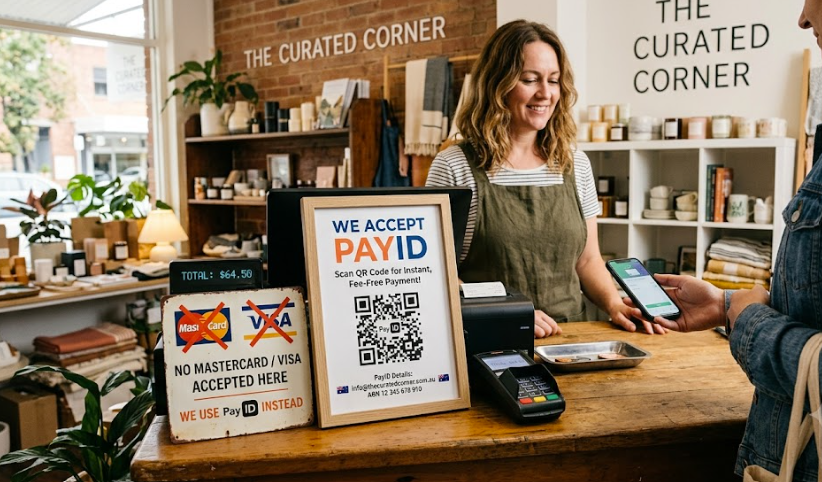
Don't just write down your PayID details in plain text. Generate a standardized PayID QR code and place it on your digital invoices, physical service desk, or e-commerce checkout. Customers simply open their preferred Australian banking app, scan the code, and authorise the instant bank-to-bank transfer.
3. Mitigate Credit Card Processing Risks
By transitioning customers to PayID, you completely eliminate:
-
Chargeback Risks: Credit card disputes can result in unfair merchant penalties and lost revenue. PayID transfers are bank-authorised and irreversible by consumers via standard card scheme rules.
-
Settlement Delays: No more waiting 1–3 business days for merchant processors to clear funds. PayID cash hits your account in real-time, 24/7.
-
Infrastructure Dependence: If a global card gateway goes down, your business can still operate seamlessly.
4. Direct Customers with Smart Incentives
While you won't be able to pass on credit card surcharges under upcoming rules, you can still reward positive customer behaviour. Consider offering a small payment incentive (such as a "PayID Prompt Payment" fast-track on orders or a minor loyalty bonus) to encourage customers to scan and pay directly from their accounts.
5. Standardise Your Messaging
Many Australians are unaware that PayID is built for commerce, often assuming it is only for peer-to-peer transfers. Create simple, transparent signage or invoice footers that read: "Skip card merchant delays. Pay instantly and securely with PayID using our ABN."