22 October, 2026
Thursday
BLOG

The Reality of Offshore Evolution: Why I Left Thailand
The business landscape has fractured and reformed. If the post-COVID era has taught us anything, it is that the ground beneath our feet is rarely as stable as we assume. As business owners, we are often forced to look objectively at the environments we operate in. Sometimes, the environment changes so fundamentally that the only logical response is to accept the shift and adapt.
Over the last year, I made some significant structural changes to my business operations that many did not see coming. It wasn’t a burning desire to upend my life or my organization, but a pragmatic acceptance of an evolving reality. I had to face a hard truth: Thailand was simply no longer the right fit for my business, or for me.
Ten years ago, the logic for basing operations in Thailand was undeniable. We ran a robust back office out of the country, housing our customer service and software development teams. It made perfect financial and operational sense. But fast forward a decade, and the need for that infrastructure has completely evaporated. Today, our customer service is seamlessly and effectively handled by a leaner team in the Philippines.
On the technical side, the shift has been even more stark. Retaining software developers in Thailand has become increasingly expensive, and the language barrier remained a persistent friction point. Meanwhile, the technology sector has seen a massive migration of AI-driven development to India, Vietnam, and Sri Lanka. These markets offer incredibly deep, accessible talent pools that align far better with modern, agile development needs.
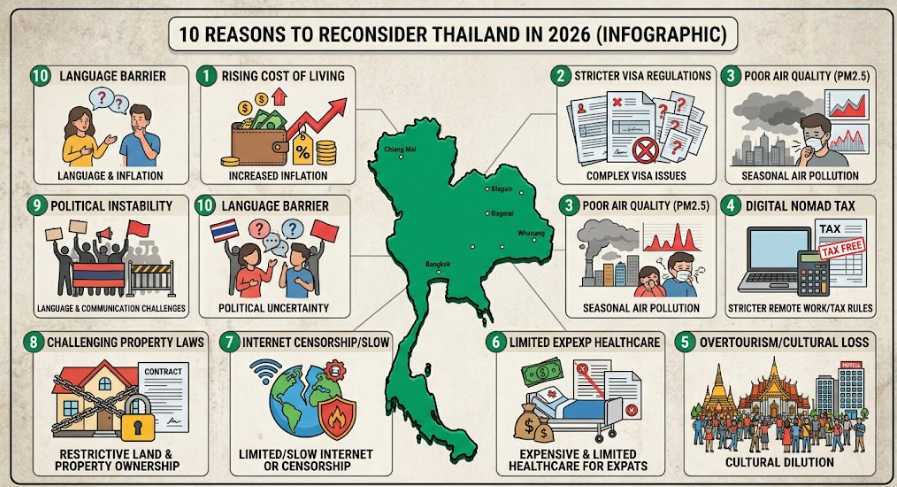
What this meant was that our Thai corporate entity existed almost entirely to support my own visa and work permit. When you look at the raw math of maintaining a company solely for founder residency, the justification crumbles. The overhead is staggering. You are paying for accounting, legal retainers, and mandatory annual audits. You are navigating shifting local tax regulations for expatriates and foreign-sourced income, alongside endless bureaucratic red tape. Add in the rising costs of operating locally and the broader regional disputes impacting the area, and the model simply breaks down. It is no longer a viable, streamlined option for multinational operators.
As a CEO and founder, I had to take a hard look in the mirror and accept that the very reasons I took my company offshore to Asia fifteen years ago have dramatically reversed. The market evolved. Technology evolved. The cost-benefit ratio inverted. Ultimately, I concluded that it was not only in the company’s best financial interest to simplify our operations, but it was also vital for my own personal productivity to reconsider my location in the Asia Pacific. Relocating back to a more grounded, frictionless operating base in Sydney allowed me to strip away the administrative bloat and focus entirely on moving the business forward.
There is a vital lesson here for anyone running a multinational operation: Never let sentimentality outvote strategy. Always be willing to reassess your footprint. As markets shift, the ability to pivot and abandon old models without hesitation isn’t just good management—it is basic survival.
— Cameron McKean